

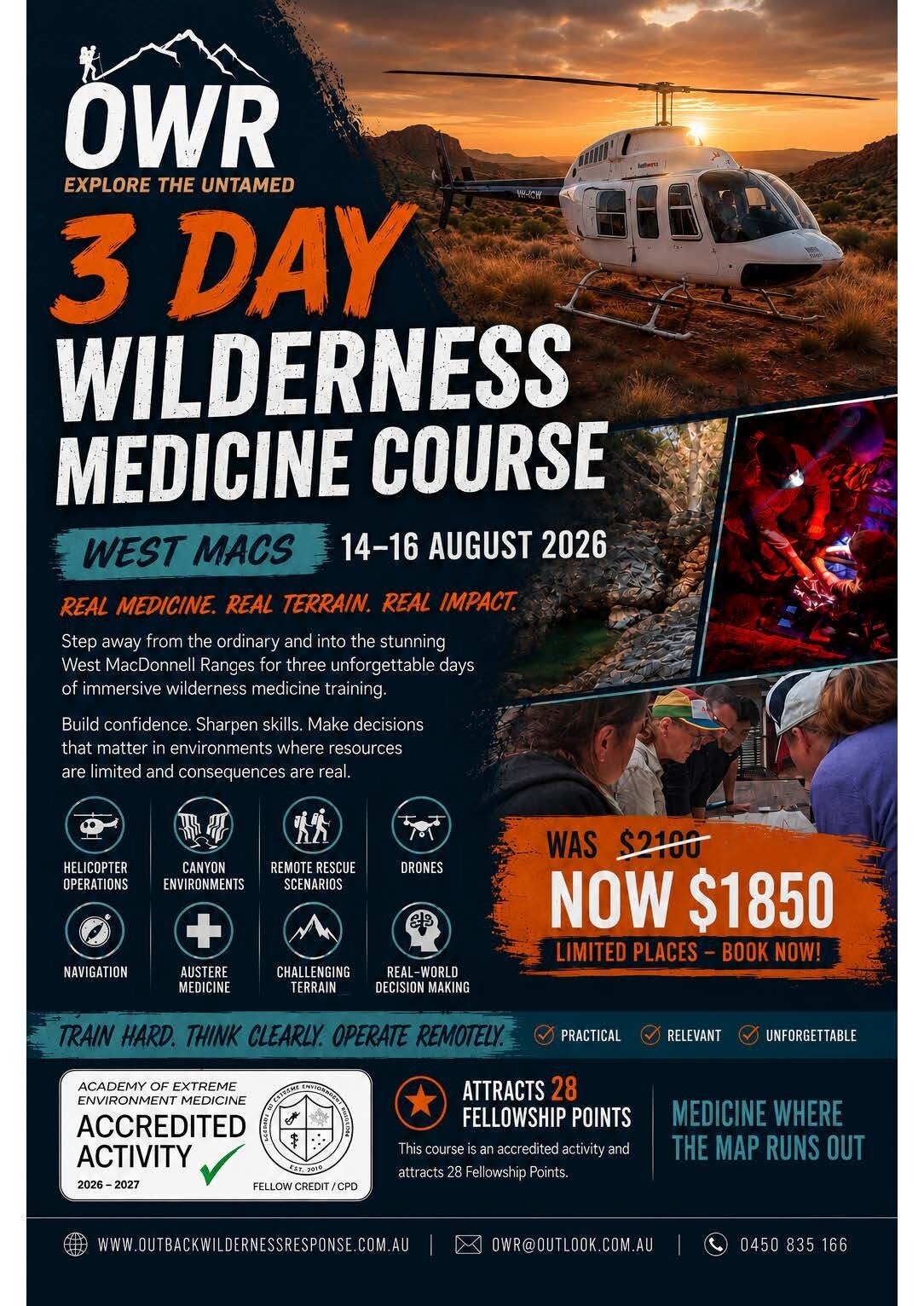
3 Day Wilderness Medicine Course August 14-16
OUTBACK WILDERNESS RESPONSE
3-Day Wilderness Medicine Course
Navigation. Survival. Remote Medicine.
West MacDonnell & Chewings Ranges, Northern Territory
When you are hours from help, your clinical skills are only one part of the mission.
This 3-day wilderness medicine course is built around the realities of remote care: difficult terrain, heat, distance, navigation challenges, limited equipment, delayed rescue, team decision-making and patient care beyond the track.
Set in the stunning West MacDonnell and Chewings Ranges, participants will explore remote Central Australian terrain while developing practical skills in navigation, survival, wilderness medicine and remote rescue.
This is not a standard classroom course.
This is medicine where the map runs out.
Course Dates
26–28 June 2026
17–19 July 2026
14–16 August 2026
Course begins on the morning of Day 1 and finishes late afternoon on Day 3.
Pick-up and drop-off from Alice Springs can be arranged.
What to Expect
Across three days, participants will move between practical teaching, field-based skills, hiking, camping, navigation activities and realistic wilderness medicine exercises.
The course is designed to build confidence in remote environments where help may be delayed, communications may be limited and the terrain itself becomes part of the problem.
Day 1 — Remote Readiness & Field Skills
Participants begin with an introduction to operating safely in remote Central Australia, including environmental risk, team safety, communication planning and basic navigation concepts.
The day includes practical field skills, wilderness medicine foundations and preparation for operating away from easy access to vehicles, clinics or hospitals.
Participants will begin developing confidence in moving through remote terrain, assessing risk and preparing for field-based patient care.
Day 2 — Navigation, Survival & Live Wilderness Exercises
Day 2 takes participants deeper into the landscape, with a stronger focus on navigation, survival priorities and scenario-based learning.
Participants may be involved in hiking-based activities, search-style tasks, patient access challenges, remote treatment scenarios, team problem-solving and delayed rescue planning.
The course includes camping and night-based activities, giving participants exposure to the challenges of operating after dark, managing fatigue, maintaining situational awareness and continuing patient care in difficult conditions.
Day 3 — Remote Rescue & Integrated Scenario Learning
The final day brings the course together with more complex field exercises and team-based scenarios.
Participants will apply navigation, survival, clinical care, communication, packaging and evacuation planning in realistic wilderness situations.
The focus is on practical decision-making, leadership, patient safety, team safety and understanding how to manage a remote incident from first contact through to evacuation planning.
Skills Covered
Navigation and route planning
Remote area safety
Survival priorities
Water, heat and shelter considerations
Emergency communication planning
Wilderness trauma care
Heat illness and dehydration
Snakebite awareness
Patient assessment in austere environments
Prolonged field care
Patient packaging and movement
Search and rescue-style thinking
Night operations principles
Evacuation and retrieval planning
Team leadership and decision-making
Live Field Experiences
Participants can expect a highly practical course involving:
Hiking through remote terrain
Camping in the West Macs region
Navigation-based challenges
Survival-focused activities
Night operations
Search and rescue-style exercises
Remote patient care scenarios
Canyon, gorge and range-based learning environments
Patient packaging and evacuation planning
Beautiful Central Australian landscapes
Who This Course Is For
This course is designed for:
Doctors
Paramedics
Nurses
Rescue workers
Park rangers
Outdoor guides
Remote workers
Expedition leaders
Emergency services personnel
Adventure and trekking staff
You do not need to be an expert navigator or survival specialist. The course is designed to build practical confidence in remote and austere environments.
Accreditation
Accredited through the Academy of Extreme Medicine for 28 Fellowship Points.
Why Train With OWR?
Remote medicine is more than clinical treatment.
It is knowing how to move, survive, communicate, lead, improvise and make decisions when resources are limited and help is not close.
The West MacDonnell and Chewings Ranges provide one of the most spectacular outdoor classrooms in Australia — rugged, remote, beautiful and unforgiving.
This course brings together navigation, survival and wilderness medicine in a practical, hands-on adventure-based learning experience.
Bookings & Enquiries
Email: owr@outlook.com.au
Phone: 0450 835 166
Limited places available.
Outback Wilderness Response
Navigation. Survival. Medicine beyond the track.